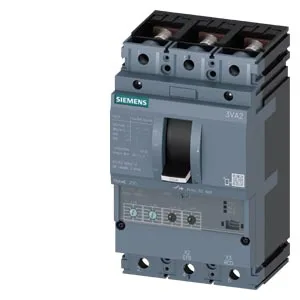
What this MCCB is and what its ratings mean for your panel
The Siemens 3VA2216-6HN32-0AA0 is a SENTRON molded case circuit breaker (MCCB) rated for line protection — the primary role is protecting cable and bus from short-circuit and overload in a distribution panel or switchboard. Three poles, 160 A continuous current, and an ETU350 electronic trip unit that gives you adjustable long-time (tr 0.5–17 s) and short-time delay (tsd up to 0.4 s) for selectivity coordination downstream. Breaking capacity is the headline number that decides whether this breaker survives a fault without exploding. At 240 V it clears 242 kA — that is utility-grade fault current, typical for a main breaker on a large transformer secondary. At 415 V and 440 V it still holds 187 kA, and at 500 V it manages 121 kA. Only at 690 V does it drop to 4.5 kA, which still covers most industrial motor-circuit faults at that voltage. If your panel's available fault current at the line side exceeds these numbers at the relevant voltage, you need a higher-rated frame. The 160 A rating holds flat from 40 °C through 70 °C — no derating curve to worry about in a warm enclosure. That is unusual; most MCCBs start derating above 40 °C. The ETU350 release lets you dial in the protection curve to match your load, which is what makes this breaker suitable for both feeder and downstream distribution without swapping trip units.
Panel fit and integration notes
Dimensions: 181 mm high, 105 mm wide, 86 mm deep. That 105 mm width is the standard 3-pole MCCB footprint for this SENTRON frame size — it occupies three 35 mm DIN-rail modules (each 35 mm wide) plus a sliver for the arc chamber. The 86 mm depth means it projects less than 90 mm from the mounting surface, which fits a 200 mm deep enclosure with room for wiring gutters. IP40 on the front — protected against tools and wires >1 mm, but not sealed against water. That is standard for panel-mounted breakers; keep it behind a locked door or a gland plate if the environment is wet. The ETU350 is a solid-state trip unit with no communication function — no Modbus or PROFIBUS onboard, so fault reporting is local via the LED indicator and mechanical flag. Latching endurance of 20 000 operations.
