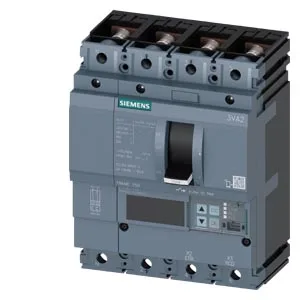
Its interrupting capacity hits 242 kA at 240 V, 187 kA at 415 V and 440 V, then drops to 121 kA at 500 V and 4.5 kA at 690 V. That means it detects leakage by comparing the vector sum of phase and neutral currents — a common method for protecting against ground faults on solidly-grounded systems without needing a separate GFCI module. It carries a communication function onboard, so it can report status and trip events to a PLC or BMS over the plant network — useful for a maintenance team trying to figure out which breaker tripped at 2 AM without walking the panel.
Panel fit — dimensions and thermal derating
That 86 mm depth (3.39 in) is the dimension that matters for gland-plate clearance and enclosure depth — a shallow 200 mm deep panel might leave the breaker terminals kissing the back wall if you don't account for wiring space. No need to downrate for a warm panel — that's unusual for an MCCB and simplifies the panel builder's life. Maximum power loss is 19.7 W.
What it does not carry
No undervoltage release, no voltage trip, no trip indicator. If your safety circuit requires an undervoltage coil to drop the breaker on loss of control power, this variant won't do it without an add-on accessory.