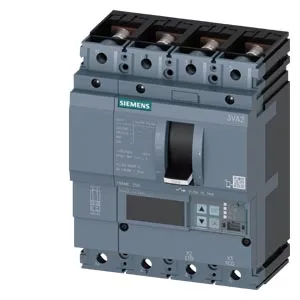
Siemens 3VA2216-6KQ42-0AA0 SENTRON MCCB — 160 A, 4-Pole, Line Protection
It carries a continuous current rating of 160 A across the full ambient temperature range from 40 °C to 70 °C, with no derating needed up to that ceiling — the rated current holds at 160 A from 40 °C all the way through 70 °C, which simplifies panel sizing in warm enclosures. The adjustable thermal-magnetic trip unit covers a range from 240 A minimum to 1 920 A maximum, giving you selectivity headroom for downstream feeders. Breaking capacity is the headline number here: 242 kA at 240 V, 187 kA at 415 V and 440 V, 121 kA at 500 V, and 4.5 kA at 690 V.
The 86 mm depth leaves room for rear-connected busbars or cable lugs in a shallow enclosure.
Communication and Monitoring Capability
This variant includes a communication function and an other measurement function, plus ground-fault monitoring via summation current formation on the L + N conductor. That means it can report current, power, and ground-fault data over a bus — typically PROFIBUS or PROFINET on the 3VA2 platform — without an external CT or metering module. The ground-fault detection sums the phase and neutral currents to sense leakage, which is useful on solidly-grounded systems where you want to alarm on residual current without a separate GFCI.