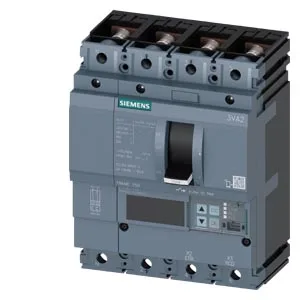
The Siemens 3VA2216-7JQ32-0DH0 is a 3-pole IEC frame 250 circuit breaker with a 110 kA breaking capacity at 415 V — class C, meaning it clears high fault currents typical of large distribution transformers or close-coupled switchgear without cascading upstream. The ETU560 trip unit gives you LSIG protection: long-time (L) overload adjustable Ir=63A...160A, short-time (S) pickup Isd=0.6..10x In, instantaneous (I) Ii=1.5..12x In, and ground-fault (G) Ig=0.2...1 x In with time delay tg=0.05-0.8s. That ground-fault element can be switched off, which matters if you're feeding a downstream transformer where inrush might nuisance-trip the G function. The nut keeper kit and undervoltage release (UVR) at 208-230 V AC 50/60 Hz are factory-fitted, so you don't lose DIN-rail space adding them later. Two HQ auxiliary switches plus one HQ trip alarm switch give the PLC or BMS a clean status read — no separate interface relay needed.
Integration into the enclosure
The UVR coil draws from a 208-230 V AC control transformer — verify the secondary is sized for the coil's inrush if you're sharing that tap with other contactors or relays. The auxiliary switches (2 HQ + 1 trip alarm HQ) are wired to the terminal block on the breaker face; no additional mounting kit is needed.
Selectivity and coordination
With Icu=110 kA at 415 V, this breaker sits comfortably upstream of downstream 25 kA or 36 kA rated devices — the full rating is available for the fault path, not derated by a weak upstream device. The LSIG settings let you shape the time-current curve for selective coordination with downstream MCCBs or fuses. The short-time pickup (Isd) range of 0.6..10x In and the ground-fault time delay (tg) of 0.05-0.8 s give enough band to ride through motor starting or transformer inrush without tripping the main.