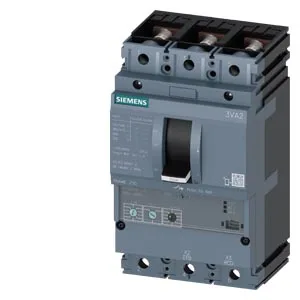
The 3-pole unit breaks up to 330 kA at 240 V and still holds 242 kA at 415/440 V, so it handles high-fault scenarios on the line side of a motor starter without cascading upstream.
Breaking capacity is the headline: 330 kA at 240 V AC, 242 kA at 415/440 V, 187 kA at 500 V, and 4.5 kA at 690 V. Trip time is adjustable between 4 s and 17 s, which is the long-time delay band for overload protection. That range suits motor starting inrush — a 160 A motor might pull 800 A for a few seconds during acceleration, and a 4 s minimum delay lets the breaker ride through a normal start without nuisance tripping. The 17 s maximum gives headroom for longer acceleration profiles on high-inertia loads like centrifuges or large fans. Power loss is 22.2 W maximum at rated load. That's moderate for a 160 A frame — it means the breaker dissipates heat into the enclosure, so if you're packing multiple units in a sealed cabinet, factor that into the thermal budget.
The 86 mm depth fits in a standard enclosure without door interference. This variant comes with an undervoltage release (UVR) integrated — the auxiliary release type is listed as undervoltage release. There is no auxiliary switch and no ground-fault monitoring on this version, so if you need those, look at the 3VA2 family with those options. The basic switch inside is order code 3VA2216-7MN32-0AA0, which is the core switching mechanism; the -0BA0 suffix adds the UVR and phase-failure electronics.