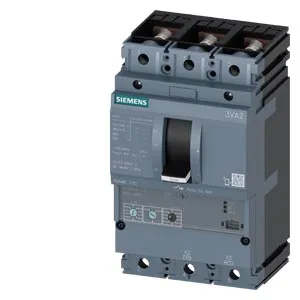
The Siemens SENTRON 3VA2216-7MN32-0DH0 is a 3-pole molded case circuit breaker rated a full 160 A across the entire operating temperature band from 40 °C to 70 °C — no derating curve to chase when the panel runs hot. That flat thermal profile matters for motor protection circuits where ambient inside the enclosure can climb well past 50 °C. Breaking capacity hits 330 kA at 240 V AC, stepping down to 242 kA at 415 V and 440 V, then 187 kA at 500 V. For a motor protection MCCB, that SCCR headroom means it can sit upstream of a line of smaller breakers without cascading failure on a high-fault bolted fault. This is a motor protection design — the trip curve and auxiliary switch complement are tuned for starting inrush and overload profiles on induction motors, compressors, and pumps.
Panel fit and aux switching
Footprint is 105 mm wide × 181 mm tall × 86 mm deep — standard 3-pole MCCB envelope for a 160 A frame. That gives three independent signal paths: two for status feedback (open/closed) and one dedicated to the trip event. Useful for a PLC input that needs to distinguish a manual open from a fault trip without extra wiring. Max power loss is 22.2 W — within the range for a 160 A frame, but worth noting if you're packing multiple breakers in a sealed enclosure.