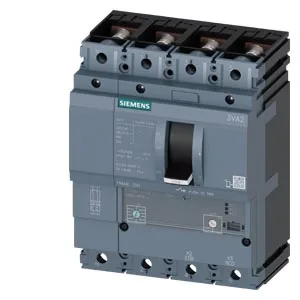
The Siemens SENTRON 3VA2216-8HK42-0AA0 is a 4-pole molded case circuit breaker (MCCB) rated for 160 A continuous current across the full ambient range from 40 °C to 70 °C — no derating needed up to that ceiling. That 160 A is the uninterrupted current the breaker carries without tripping; the interrupting ratings tell you what it can safely clear in a fault: 440 kA at 240 V, 330 kA at 415 V and 440 V, 220 kA at 500 V, and 52.5 kA at 690 V. The ETU340 electronic trip unit gives adjustable long-time, short-time, instantaneous, and ground-fault protection curves, so you coordinate selectivity with downstream breakers rather than relying on a fixed thermal-magnetic curve. The N-conductor protection is adjustable: OFF, 50 %, or 100 % of the phase current, giving flexibility for 3-phase + N applications where the neutral may carry unbalanced load.
What the ETU340 trip unit gives you
The ETU340 is an electronic trip unit with LSI protection (long-time, short-time, instantaneous) plus ground-fault (G) capability. Unlike a thermal-magnetic breaker, it offers adjustable time-current curves, so you can set the short-time pickup and delay to coordinate with downstream MCCBs or fuses. The ground-fault function is integral — no external relay needed. The N-conductor protection adjustment (OFF / 50 % / 100 %) is set via a rotary switch on the front.