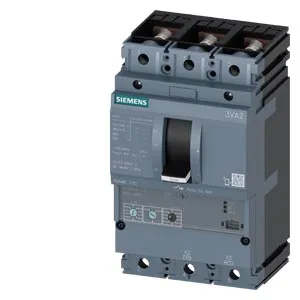
This isn't a general-purpose distribution breaker — the ETU350M electronic trip unit gives it phase-failure detection and a dedicated motor-protection curve, so it tracks overload on an induction motor without nuisance tripping from inrush.
Breaking capacity that survives the nacelle
Rated breaking capacity hits 330 kA at 240 VAC and still delivers 242 kA at 415 V and 440 V. At 690 V it holds 52.5 kA. That kind of headroom matters when the breaker sits downstream of a multi-megawatt turbine transformer — fault currents on a 690 V wind-farm collector ring can spike hard, and this MCCB clears them without cascading upstream.
Thermal derating — the real-world number
Full 200 A holds up to 50 °C ambient. At 55 °C it derates to 192 A, at 60 °C to 188 A, and at 70 °C to 180 A. In a sealed turbine nacelle that hits 60 °C on a summer afternoon, you still have 188 A of continuous capacity — no up-tower swap needed. That covers cold-climate turbine parks and desert solar hybrid sites alike.
Trip unit and auxiliary releases
The ETU350M is an electronic overcurrent release with adjustable settings for motor protection. It includes phase-failure detection, so a lost phase on a conveyor drive or pitch motor trips before the winding cooks. A shunt trip (STL) release is built in — voltage-triggered, so a remote safety PLC or E-stop relay can drop the breaker without a mechanical linkage. If you need remote status feedback, add an auxiliary contact block separately.
Mechanical endurance and power loss
Rated for 20,000 mechanical operations — sufficient for a motor-starting duty cycle on a pump or fan that cycles a few times per shift. Maximum power loss is 75 W, which matters for thermal management inside a compact panel or nacelle cabinet.