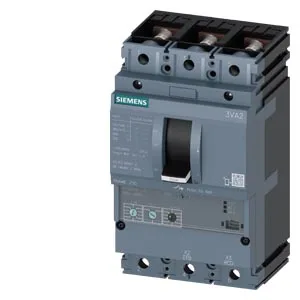
That flat thermal curve is unusual; most MCCBs begin to derate above 40 °C, so this part suits a warm enclosure or a panel sited near process heat without recalculating the ampacity. The interrupting ratings climb to 330 kA at 240 V and 242 kA at 415 V and 440 V, dropping to 187 kA at 500 V and 5.4 kA at 690 V. Three-pole construction with an ETU350M electronic trip unit.
That 105 mm width is a standard 3-pole MCCB footprint for a 200 A frame — it fits the same cutout and bus-bar spacing as other SENTRON 3VA2 breakers, so a panel laid out for a 3VA2 160 A or 250 A unit accepts this one without re-drilling the mounting plate. Maximum power loss is 46 W at rated current. That matters for thermal management inside a sealed cabinet: if you cluster several breakers at full load, the combined dissipation can push internal temperature above the 70 °C operating maximum, so leave some air gap or forced ventilation.
Rated insulation voltage is 800 V, and the operating temperature range spans -25 °C to +70 °C, with storage from -40 °C to +80 °C. For a motor-protection breaker that cycles infrequently (a few times per shift at most), that figure is more than adequate; for a machine that cycles every few minutes, consider a contactor for the switching duty and let the MCCB serve as backup protection only.