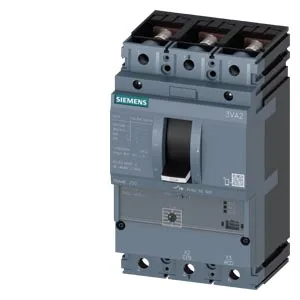
That means it's the overcurrent and short-circuit protection device between a motor starter contactor and the motor — it handles the high inrush without nuisance tripping, but clears fast on a bolted fault. It carries a shunt trip release (STL) built in, which lets a safety PLC or E-stop relay drop the breaker remotely. The interrupting capacity is serious: 330 kA at 240 V, 242 kA at 415 V and 440 V, 187 kA at 500 V, and still 52.5 kA at 690 V. At 200 A continuous, it handles motor loads in that range; the thermal derating curve shows full 200 A up to 50 °C, then drops to 192 A at 55 °C, 188 A at 60 °C, 184 A at 65 °C, and 180 A at 70 °C. The maximum power loss is 75 W, so plan some ventilation if you're packing several in a closed cabinet.
What's in the box and what's not
The breaker ships as a complete unit with the ETU310M trip unit and the shunt trip (STL) installed. If you need auxiliary contacts or a UVR, you'll add them separately. The trip indicator is not fitted, so you won't get a visual flag on the front; the shunt trip gives you the electrical status feedback.
Temperature and handling notes
The mechanical endurance is 20,000 operations — that's the latching mechanism life, not the electrical life under load. For motor starting duty, the electrical life will be lower depending on the switching frequency and load current.