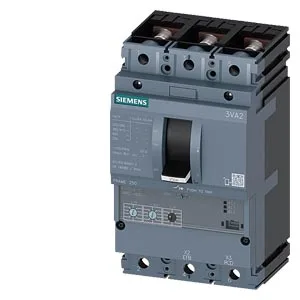
At 415 V and 440 V that figure holds at 121 kA, then drops to 75.6 kA at 500 V and 4.5 kA at 690 V. The 250 A rating holds flat from 40 °C through 50 °C ambient; above that it derates to 241 A at 55 °C, 232 A at 60 °C, 222 A at 65 °C, and 213 A at 70 °C. That means in a warm panel — say 55 °C internal ambient — you lose 9 A of headroom. If your load pulls a steady 245 A and the panel runs hot, this breaker will nuisance-trip or run at the edge of its thermal curve. That gives you remote trip indication and a separate alarm contact for the SCADA or PLC input — useful for a downstream fault that opens this main breaker. No undervoltage release is fitted, so a loss of control power does not drop the breaker; if you need UVR protection for a motor feeder, this variant is not the one. Max power loss is 48 W at rated load — that is the heat the breaker dumps into the enclosure. In a sealed, non-ventilated panel at 50 °C ambient, that 48 W plus the other gear's dissipation can push internal air past the 55 °C derate threshold. Plan the thermal budget accordingly.
That is a standard SENTRON 3VA2 footprint — it occupies the same cutout and bus-bar spacing as other 250 A frames in the series. If your existing panel was built around a 5SQ2370-2YA05, the 105 mm width and 181 mm height match closely, but the 3VA2's terminal layout and accessory slot positions are not identical — a wiring review is needed.
Environmental and compliance range
The breaker carries a trip indicator and a voltage trigger for remote operation. No ground-fault monitoring version is fitted — this is a straight line-protection device without integral GFCI.