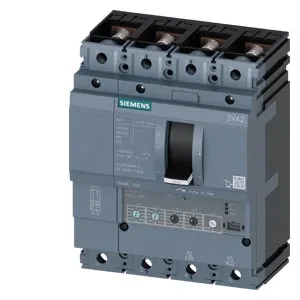
Rating and trip unit — what drives the BOM decision
The Siemens 3VA2225-5HM42-0DF0 is a 4-pole SENTRON molded case circuit breaker rated 250 A continuous at 40 °C through 50 °C, with a slight thermal derating curve beginning at 55 °C (241 A) and stepping down to 213 A at 70 °C. That flat plateau from 40 °C to 50 °C means the breaker delivers its full nameplate current in most panel environments without requiring a derate factor — useful when the enclosure runs warm from adjacent drives or transformers. The ETU330 electronic trip unit handles the overcurrent protection logic. It is a line-protection variant, meaning it is configured for feeder and distribution duty rather than motor or generator protection — the trip curves and time-delay settings are tailored for cable and busbar protection in a main or sub-distribution panel. Breaking capacity is substantial: 187 kA at 240 V, 121 kA at 415 V and 440 V, 75.6 kA at 500 V, and 4.5 kA at 690 V. At 415 V — the common industrial distribution voltage in many markets — the 121 kA figure gives headroom for high-fault installations without cascading upstream breakers, provided the SCCR study confirms the available fault current stays under that ceiling.
Physical fit and panel integration
Dimensions are 181 mm high, 140 mm wide, 86 mm deep. The 140 mm width for a 4-pole frame is standard for this class — it fits the common Siemens 3VA mounting footprint, so a panel laid out for a 3VA2 frame will accept this unit without drilling new cutouts or relocating DIN rails. Front protection is IP40 — suitable for enclosed panel mounting where the breaker face is behind a door or cover. Not rated for washdown or outdoor exposure; keep it inside a rated enclosure.
Lifecycle and sourcing posture
The auxiliary contact configuration is 1 auxiliary switch plus 1 trip alarm switch HQ — this is the factory-fitted switching set for status feedback and remote trip indication. The undervoltage release is present, so the breaker can be shunt-tripped via a separate control voltage for emergency-stop or undervoltage protection schemes.
