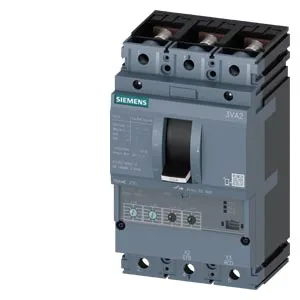
What the interrupting ratings mean for your fault-current study
Its interrupting capacity is 187 kA at 240 V AC, 121 kA at 415 V AC, 121 kA at 440 V AC, 75.6 kA at 500 V AC, and 4.5 kA at 690 V AC. That spread covers most industrial distribution voltages — the 187 kA at 240 V handles high-fault panels fed by large transformers, while the 4.5 kA at 690 V is a reminder that the same breaker is still usable on 690 V systems but only where the available fault current stays under that threshold.
Thermal derating — the current you actually get above 55 °C
Above that it derates linearly: 241 A at 55 °C, 232 A at 60 °C, 222 A at 65 °C, and 213 A at 70 °C.
Physical fit and auxiliary configuration
The base switch variant is 3VA2225-5HN32-0AA0; this order code adds the auxiliary switches.