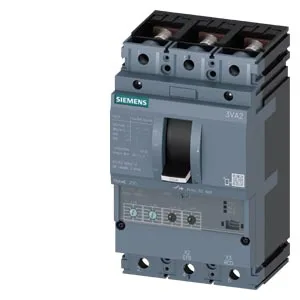
What it is and what the ratings mean
The Siemens SENTRON 3VA2225-5HN32-0AF0 is a 3-pole molded case circuit breaker (MCCB) rated for line protection duty, carrying 250 A continuous at 40 °C — the number that governs your feeder sizing, not a higher short-time rating. At 240 V it interrupts 187 kA, at 415/440 V it holds 121 kA, and at 690 V it still clears 4.5 kA. That 187 kA at 240 V means it can sit upstream of a large step-down transformer or a high-fault panel without needing a current-limiting fuse ahead of it; the 121 kA at 415 V covers most European industrial distribution. The 250 A frame is fully rated across the 40–50 °C band with no derating, then steps down to 213 A at 70 °C — useful if the breaker lives near a heat source or in a poorly ventilated enclosure.
Panel fit and integration
The breaker measures 105 mm wide, 181 mm tall, and 86 mm deep — a standard 3-pole MCCB footprint that fits most DIN-rail or backplate layouts. The 86 mm depth is the dimension that matters when you're closing the gland plate or fitting a dead-front cover; it leaves clearance for the arc-chamber venting path. The 105 mm width means it occupies three 35 mm DIN spaces plus a sliver of inter-pole air gap. Maximum power loss is 48 W, so check your enclosure's thermal budget if the panel is densely packed.
Built-in diagnostics and auxiliary switching
A trip indicator is standard — you get a visual flag that the breaker opened on a fault, not a manual switch-off. The auxiliary switch configuration is 1 auxiliary + 1 trip alarm switch HQ, which gives you both a position-follow contact and a separate contact that only closes on a trip event. That pair lets a PLC or SCADA system distinguish between a commanded open and a protective trip without extra wiring. No undervoltage release, no ground-fault monitoring, and no communication module on this variant; it's a straight line-protection MCCB with local signaling only.
