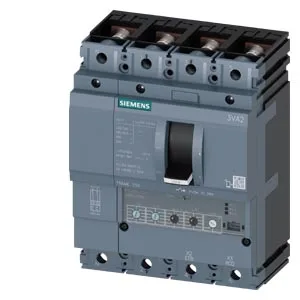
It is rated for 250 A continuous current, and the 4-pole construction handles three-phase-plus-neutral applications. The 250 A rating holds up to 50 °C; above that, the thermal derating curve drops it to 241 A at 55 °C, 232 A at 60 °C, 222 A at 65 °C, and 213 A at 70 °C, so an enclosure with poor airflow or a hot ambient means you size up or accept the reduced ampacity. Breaking capacity is the headline figure for a main breaker: 187 kA at 240 V, 121 kA at 415 V and 440 V, 75.6 kA at 500 V, and 4.5 kA at 690 V. At 690 V the 4.5 kA figure is modest; if the system voltage is 690 V and the available fault current exceeds that, this breaker is not the right choice for that tap. The breaker ships with the basic switch variant 3VA2225-5HN42-0AA0 and is fitted with two HQ auxiliary switches. Maximum power loss is 48 W, which matters for enclosure heat-rise calculations if it is running near full load continuously.
The 140 mm width for a 4-pole 250 A MCCB is standard for the SENTRON 3VA2 frame — it will drop into a panel cutout or DIN-rail adapter designed for that frame.
What it is not (so you don't order the wrong variant)
No trip indicator, no voltage trigger, no communication function, no other measurement function. If your panel requires remote monitoring or a visible trip flag, this is not the version. The 3VA2 family has variants with electronic trip units, Modbus, and ground-fault; the 3VA2225-5HN42-0AC0 is the thermal-magnetic, no-communications base model.