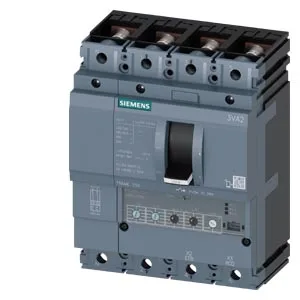
Selectivity and coordination — where the ratings matter
The ETU350 electronic trip unit gives adjustable long-time, short-time, and instantaneous protection bands, which is what you need for selective coordination downstream. The 250 A frame with 121 kA SCCR at 415 V means it can sit at the main or feeder position in a 400 V industrial panel and clear a bolted fault without upstream devices having to intervene — provided the let-through energy is coordinated with the next breaker down. The 4.5 kA rating at 690 V is a reminder that this frame is optimized for 240–500 V systems; at 690 V the interrupting capacity drops sharply, so verify the available fault current if that's your service voltage.
Thermal derating — the real-world continuous current
At 55 °C it drops to 241 A, at 60 °C to 232 A, at 65 °C to 222 A, and at 70 °C to 213 A. That's a tighter derating curve than some thermal-magnetic frames, so you don't lose as much headroom at elevated temperatures.
The UVR means the breaker trips if the control voltage drops — a standard safety feature for motor feeders or emergency-stop chains. No ground-fault monitoring is included, so if GF protection is required, it must be added externally or via a different variant.
Mounts to a backplate via the standard MCCB footprint — not DIN-rail, so plan for screw-fixed mounting. The 140 mm width matches the common 4-pole frame envelope for this current class; verify the busbar or cable lug centers against your existing tap-off bars. The ETU350 is field-configurable via rotary dials on the front face, no software needed for basic settings.