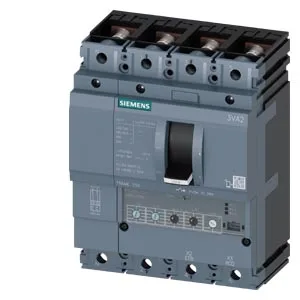
What this MCCB is and what it does
The Siemens SENTRON 3VA2225-5HN42-0DA0 is a 4-pole molded case circuit breaker (MCCB) rated for 250 A continuous current at 40 °C, designed for line protection in distribution panels and switchgear assemblies. It carries a 187 kA interrupting capacity at 240 V, which means it can safely clear a fault of that magnitude without upstream devices needing to trip — a selectivity advantage in high-fault installations like transformer secondaries or large motor control centers.
Ratings and what they mean for fit
The 250 A rating holds flat across 40 °C to 50 °C, then derates to 241 A at 55 °C and 213 A at 70 °C — so in a hot panel (say, next to a drive or transformer), the actual usable current drops. The interrupting capacity steps down as voltage rises: 187 kA at 240 V, 121 kA at 415/440 V, 75.6 kA at 500 V, and 4.5 kA at 690 V. At 690 V the 4.5 kA figure is low enough that you need to verify the available fault current at that voltage before committing the BOM line. The breaker includes an undervoltage release (UVR) as the auxiliary release — it will trip if the control voltage drops below a set threshold, which is useful for emergency-stop circuits or to prevent automatic restart after a power loss. There is no ground-fault monitoring, no communication module, and no auxiliary switch built in; those would need external accessories.
Physical fit and panel integration
The breaker measures 140 mm wide, 181 mm tall, and 86 mm deep — a standard SENTRON 3VA frame size that fits the usual DIN-rail or screw-mount patterns in a distribution panel. The 86 mm depth is the dimension to watch when the enclosure door clearance is tight, especially with cable glands or busbar connections on the line side.
