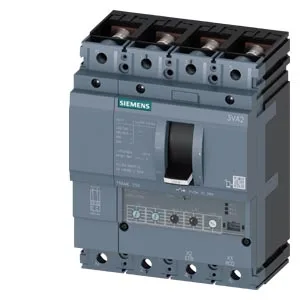
The Siemens SENTRON 3VA2225-5HN42-0HC0 is a 4-pole molded case circuit breaker rated for 250 A continuous at 40 °C, sized for line-protection duty in distribution panels. Its interrupting capacity hits 187 kA at 240 V AC, dropping to 121 kA at 415/440 V and 75.6 kA at 500 V — enough headroom for most industrial service-entrance or feeder applications where high fault current is a given.
What the ratings mean for fit
The 250 A continuous rating holds flat from 40 °C through 50 °C — no derating needed in a warm panel. At 55 °C it drops to 241 A, at 60 °C to 232 A, and at 70 °C to 213 A. That thermal curve means this breaker can sit in a moderately hot enclosure without losing much margin, but above 50 °C you need to check the actual load against the derated value. Breaking capacity of 187 kA at 240 V puts it in the high-interrupting class — it will clear a bolted fault on a large transformer secondary without cascading upstream. At 690 V the rating drops to 4.5 kA, so it is not a primary choice for 690 V distribution unless the available fault current is known to be low. The 86 mm depth and 140 mm width fit a standard MCCB footprint on DIN rail or panel-mount. At 181 mm tall, it occupies about the same vertical space as other 250 A frame breakers, so retrofitting into an existing SENTRON or third-party panel is straightforward as long as the busbar spacing accommodates 4-pole.
Deployment context
This MCCB is designed for line protection in distribution panels — think main or feeder breakers in industrial switchboards, commercial building risers, or machine-tool incoming supplies. The 4-pole configuration handles three-phase-plus-neutral or three-phase with a switched neutral, common in North American and European panel builds. The shunt trip allows remote tripping from an E-stop or fire-alarm relay, while the two HQ auxiliary switches give status feedback to a PLC or SCADA.
