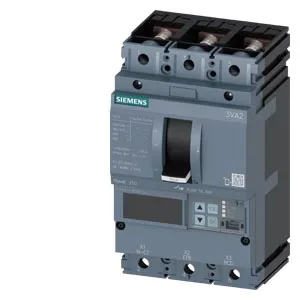
The Siemens SENTRON 3VA2225-5JP32-0KA0 is a 3-pole molded case circuit breaker rated 250 A continuous at 40 °C, purpose-built for line protection in distribution panels. Its breaking capacity reaches 187 kA at 240 V and 121 kA at 415 V, giving headroom for high-fault installations like industrial switchboards or transformer secondaries.
Thermal derating and continuous current reality
Rated 250 A continuous at 40 °C, the breaker holds that figure through 50 °C ambient. Above that, derating is linear: 238 A at 55 °C, 225 A at 60 °C, 213 A at 65 °C, and 200 A at 70 °C. If your panel ambient runs hot — say a sealed enclosure near a furnace line — the 70 °C figure (200 A) is the one to size against, not the nameplate 250 A. Maximum power loss is 48 W, which factors into enclosure thermal calculations.
Breaking capacity by voltage — selectivity planning
Breaking capacity varies sharply with system voltage: 187 kA at 240 V, 121 kA at both 415 V and 440 V, 75.6 kA at 500 V, and 4.5 kA at 690 V. The 690 V figure is notably lower — if your installation is a 690 V industrial network, confirm the available fault current stays under 4.5 kA, or step up to a higher-rated frame. For common 400 V-class distribution, the 121 kA rating covers most transformer-fed switchboards.
Dimensions: 105 mm wide, 181 mm high, 86 mm deep. Operating temperature range is -25 °C to 70 °C, storage from -40 °C to 80 °C. The shunt trip (STL) allows remote tripping via a control voltage — wire it to an E-stop relay or safety PLC output for coordinated shutdown sequences.