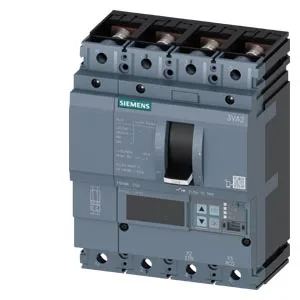
Its ETU550 electronic trip unit provides adjustable overcurrent protection with communication capability, making it suitable for selective coordination studies and remote monitoring setups.
Breaking capacity — the real-world fault clearance
This MCCB clears 187 kA at 240 V AC, 121 kA at both 415 V and 440 V, 75.6 kA at 500 V, and 4.5 kA at 690 V.
Thermal derating — what the 250 A rating really means
Above that it derates: 238 A at 55 °C, 225 A at 60 °C, 213 A at 65 °C, and 200 A at 70 °C. If the breaker lives in a crowded panel with elevated internal temperature, use the 55 °C or 60 °C figure for your load calculation — not the 40 °C nameplate. The 48 W maximum power loss also contributes to enclosure heat rise; factor it into the panel thermal budget.
The 140 mm width across 4 poles means it occupies standard MCCB mounting space in a distribution panel or switchboard. Front IP40 protection suits indoor panel installation where no washdown or dust ingress is expected. The ETU550 electronic trip unit draws its operating power from the line side — no auxiliary supply needed for the trip function, but the communication function (if used) requires a separate bus connection.
As a Siemens SENTRON product, this MCCB carries the usual IEC/EN 60947-2 certification for molded case circuit breakers. RoHS and REACH compliance documentation is available from Siemens directly. No specific UL or CSA listing is stated in the evidence; verify local code acceptance for your jurisdiction.