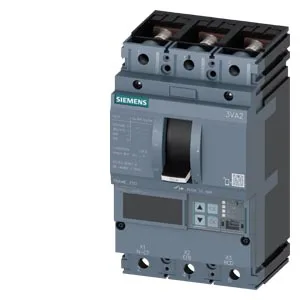
That continuous rating holds flat all the way to 50 °C — no derate needed until you push past 55 °C, where it steps down to 238 A at 55 °C and 200 A at 70 °C. The interrupting capacity climbs with the voltage curve: 187 kA at 240 V, 121 kA at 415 V and 440 V, 75.6 kA at 500 V, and 4.5 kA at 690 V.
It carries a communication function onboard, so you get remote monitoring or trip indication without an add-on module taking up extra DIN space. No undervoltage release fitted, so if the application needs UVR for motor-start interlocking, that's a separate accessory.
The 250 A full-scale value and the 375 A minimum define the adjustable thermal-magnetic or electronic trip range — you set the long-time pickup somewhere between those numbers to match the cable or load. The 48 W maximum power loss matters for enclosure heat rise: in a sealed panel at 70 °C ambient, that's 48 W the ventilation or air conditioning has to pull out.