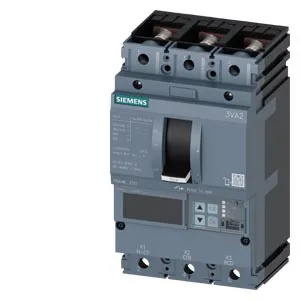
What this MCCB is and what it does
The Siemens 3VA2225-5JQ32-0BC0 is a 3-pole SENTRON molded case circuit breaker (MCCB) rated for line protection, with a continuous current of 250 A at 40 °C and a breaking capacity of 187 kA at 240 V AC. It carries an ETU560 electronic trip unit — that's a microprocessor-based release with adjustable long-time, short-time, instantaneous, and ground-fault protection curves, so you can coordinate selectivity downstream without nuisance trips. The 187 kA interrupt rating at 240 V means it can safely clear a fault up to that level without upstream fuses or breakers needing to open — critical for high-fault panels near transformers or large drives.
Key ratings — what they mean for fit
Rated continuous current Iu is 250 A, and it holds that rating from 40 °C up to 50 °C without derating. At 55 °C it's 238 A, at 60 °C it's 225 A, at 65 °C it's 213 A, and at 70 °C it's 200 A. That derating curve matters if you're packing this breaker into a warm enclosure — the 250 A frame is good for a 200 A continuous load in a 70 °C ambient, no need to oversize the frame. Breaking capacity drops with voltage: 187 kA at 240 V, 121 kA at 415 V and 440 V, 79 kA at 500 V, and 5.1 kA at 690 V. The 5.1 kA at 690 V is the weak link — if your system runs 690 V and fault current exceeds that, you need a higher-rated frame or upstream current-limiting fuses. Rated insulation voltage Ui is 800 V, so the breaker is suitable for 690 V systems (phase-to-phase) with adequate clearance. Power loss is 50.5 W maximum — factor that into enclosure thermal calculations.
Integration and panel fit
Dimensions: 181 mm height, 105 mm width, 86 mm depth. The 105 mm width is standard for a 250 A frame MCCB — it fits the same footprint as the 3VA2 family, so it drops into existing panels without re-drilling the mounting plate. It comes with two auxiliary switches (HQ type) and an undervoltage release (UVR) — the UVR is wired to a separate control circuit and trips the breaker if control voltage drops below the dropout threshold, common for emergency-stop or undervoltage protection schemes. The ETU560 trip unit supports communication (Communication Function: Yes), so you can integrate it with a BMS or SCADA system for remote monitoring and trip-event logging — useful for condition-based maintenance in critical feeders.
