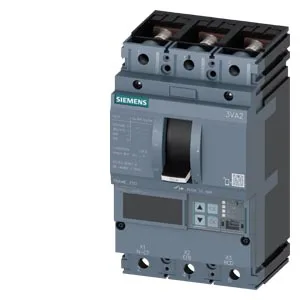
250 A SENTRON MCCB with ETU560 Trip Unit
The 3VA2225-5JQ32-0CA0: Breaking capacity is the headline spec here: 187 kA at 240 V, 121 kA at 415 V and 440 V, 79 kA at 500 V, and 5.1 kA at 690 V.
The 250 A rating holds flat from 40 °C to 50 °C, then derates linearly to 200 A at 70 °C. If this breaker lives in a non-air-conditioned enclosure near other heat sources, use the 55 °C row (238 A) or 60 °C row (225 A) for your actual continuous load calculation — don't spec it at the 250 A nameplate and hope the ambient stays cool. Dimensions are 181 mm height, 105 mm width, 86 mm depth. The 86 mm depth includes the handle and terminals; allow clearance for cable bending radius below the line-side lugs.
Trip Unit and Auxiliary Functions
Ground-fault monitoring uses summation-current sensing on the L-conductor, not a separate neutral CT. No auxiliary contact is built in, but the breaker accepts the 3VA9608-0BB24 auxiliary trip block as a field-installable add-on. Communication function is present on this variant.