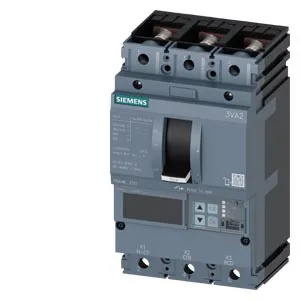
The Siemens SENTRON 3VA2225-5JQ32-0CH0 is a 3-pole molded case circuit breaker rated for 250 A continuous current at 40 °C, with an ETU560 electronic overcurrent release. The 86 mm depth by 105 mm width by 181 mm height footprint fits the standard SENTRON 3VA2 frame size. If you're swapping into an existing panel, measure the busbar spacing — the 105 mm width per pole is wider than a compact MCCB, so verify the phase-to-phase clearance on your existing mounting plate.
Thermal derating — the real-world current you can actually carry
At 55 °C it derates to 238 A, at 60 °C to 225 A, at 65 °C to 213 A, and at 70 °C to 200 A. The maximum power loss is 50.5 W, which adds to the enclosure's internal heat load; factor that into your ventilation or air-conditioning budget.
Breaking capacity by voltage — selectivity planning
The interrupting ratings step down as voltage climbs: 187 kA at 240 V, 121 kA at 415 V and 440 V, 79 kA at 500 V, and 5.1 kA at 690 V. That 5.1 kA at 690 V is the weak point — if your 690 V bus has a fault current above 5 kA, this breaker won't clear it and you need a higher-rated frame. For 400 V class systems (common in European and Asian industrial plants), the 121 kA gives plenty of headroom against typical transformer impedances. The trip indicator is present so you can spot a tripped breaker from across the panel without opening the door.
Communication and auxiliary wiring
This MCCB has a communication function — the ETU560 release supports optional communication modules for remote monitoring and trip data, though the specific protocol (PROFIBUS, PROFINET, or Modbus) depends on the plug-in module you add. Phase failure detection is not built in; if you need that, you'd add an external phase monitor.