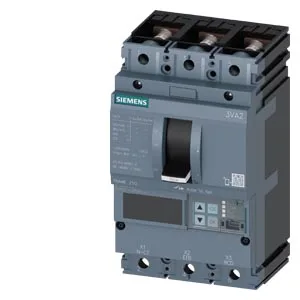
The Siemens 3VA2225-5KP32-0JC0 is a SENTRON molded case circuit breaker (MCCB) rated for 250 A continuous current at 40 °C through 50 °C — meaning it carries a full 250 A load without derating in a typical 40 °C panel ambient. Above that, the thermal curve steps down: 238 A at 55 °C, 225 A at 60 °C, 213 A at 65 °C, and 200 A at 70 °C. At 240 V it handles 187 kA; at 415 V and 440 V, 121 kA; at 500 V, 79 kA; at 690 V, 5.1 kA. The auxiliary contact version is 2 auxiliary switches HQ, and the integrated auxiliary trip is a shunt trip (STL) design. No undervoltage release, no phase failure detection, no ground fault monitoring on this variant.
Panel fit and physical integration
That 105 mm width is a standard 4-module footprint for a 3-pole MCCB in the SENTRON range — it fits the same mounting base as other 3VA2 3-pole breakers. Maximum power loss is 48 W. In a sealed, non-ventilated enclosure, that heat has to be accounted for in the thermal design. If you are packing multiple breakers in a small cabinet, derate per the ambient curve above or add forced ventilation. For frequent switching duty, check the electrical endurance curve against your load type.