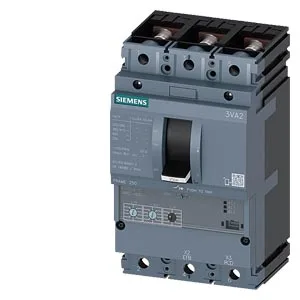
The Siemens SENTRON 3VA2225-6HL32-0CH0 is a 3-pole molded case circuit breaker (MCCB) rated for a continuous current of 250 A at 40 °C, holding that rating through 50 °C — no derating in a typical 40 °C panel. Above 50 °C it steps down: 241 A at 55 °C, 232 A at 60 °C, 222 A at 65 °C, and 213 A at 70 °C. That thermal curve matters if the breaker sits near other heat sources or in a non-ventilated enclosure; the 250 A frame is good for a 250 A feeder only if ambient stays under 50 °C. The interrupting ratings are the real story here. At 500 V it drops to 121 kA, and at 690 V it falls to 4.5 kA — so on a 690 V system this breaker is not a main, only a downstream feeder where available fault current is low. The basic switch is order code 3VA2225-6HL32-0AA0 — the -0CH0 suffix adds the UVR and the HQ auxiliary block.
Panel integration
Dimensions are 181 mm high, 105 mm wide, and 86 mm deep — a standard 3-pole MCCB footprint for a 250 A frame. The undervoltage release coil needs a separate control voltage — verify polarity and voltage rating before wiring.