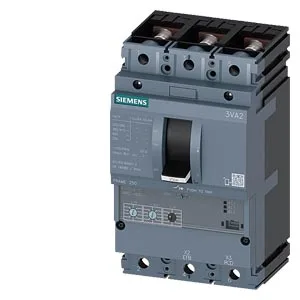
What this MCCB carries and where it fits
The Siemens SENTRON 3VA2225-6HL32-0HL0 is a 3-pole molded case circuit breaker rated for 250 A continuous current at 40 °C, with a breaking capacity of 242 kA at 240 V and 187 kA at 415 V. That 242 kA at 240 V means it can safely interrupt a fault current up to that level without the arc flashing over — critical for high-fault panels downstream of a large transformer or generator. The 250 A frame holds flat across 40–50 °C; above that it derates to 241 A at 55 °C, 232 A at 60 °C, 222 A at 65 °C, and 213 A at 70 °C. If your panel ambient runs hot, size on the 70 °C column, not the nameplate. Designed for line protection — no ground-fault monitoring, no communication module, no undervoltage release. It ships with a shunt trip (STL) and a full auxiliary switch complement: 2 auxiliary switches + 1 trip alarm switch + 1 electrical alarm switch HQ. The basic switch core is order code 3VA2225-6HL32-0AA0. Panel footprint: 105 mm wide, 181 mm tall, 86 mm deep — standard SENTRON 3VA form factor for DIN-rail or screw-mount backpanels.
Breaking capacity across voltage — selectivity planning
Breaking capacity drops sharply above 500 V: 121 kA at 500 V, then only 4.5 kA at 690 V. That 4.5 kA at 690 V is the weak leg — if your system runs 690 V line-to-line with available fault current above that, this breaker will not clear. For 400 V class panels (415–440 V) the 187 kA rating gives generous headroom for most industrial services. The minimum breaking current is 375 A, so it coordinates downstream with smaller MCCBs or fuses above that threshold.
Environmental limits and power loss
Operating temperature range -25 °C to 70 °C; storage from -40 °C to 80 °C. Maximum power loss at rated load is 48 W — relevant for enclosure thermal calculations if you pack multiple breakers in a sealed box. Trip indicator and voltage trigger are present on this variant.
