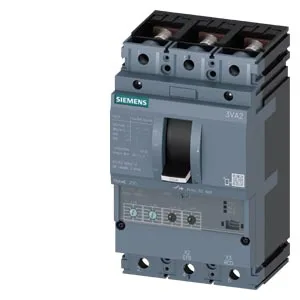
What the 242 kA interrupting rating means for your panel
The Siemens 3VA2225-6HN32-0JC0 is a SENTRON molded case circuit breaker (MCCB) rated for 250 A continuous current at 40 °C, with a 3-pole configuration and an ETU350 electronic trip unit. Its interrupting capacity hits 242 kA at 240 V AC, dropping to 187 kA at 415 V and 440 V, then 121 kA at 500 V, and 6 kA at 690 V. That 242 kA figure means this breaker can safely clear a fault at full rated current without welding contacts or rupturing the case — critical for high-fault panels near large transformers or capacitor banks where prospective short-circuit current exceeds typical 65 kA or 100 kA MCCB ratings. The ETU350 release provides adjustable long-time, short-time, instantaneous, and ground-fault protection curves, giving the site electrical engineer selectivity headroom downstream. The frame dimensions — 105 mm wide, 181 mm tall, 86 mm deep — fit the standard SENTRON 3VA mounting footprint. No trip indicator on the front face; the ETU350 communicates trip cause via its LCD or remote signaling through the HQ auxiliary switches.
Thermal derating and enclosure planning
The 3VA2225-6HN32-0JC0 holds its full 250 A rating up to 50 °C ambient. Above that, it derates linearly: 241 A at 55 °C, 232 A at 60 °C, 222 A at 65 °C, and 213 A at 70 °C. Maximum power loss is 48 W. For an MRO planner sizing a sealed stainless enclosure on a washdown line, that 48 W dissipation means the enclosure must allow natural convection or have a fan to keep internal ambient below 50 °C if the breaker runs at full load. A 250 A continuous load in a 55 °C panel forces a 241 A derate — plan the load at 240 A or ventilate.
Auxiliary and shunt trip configuration
This variant ships with 2 HQ auxiliary switches (form C, rated for control-circuit voltages) and a shunt trip (STL) release. No undervoltage release, no ground-fault monitoring module, no communication function, and no phase-failure detection are built in. The shunt trip allows remote tripping via a separate control voltage — a controls integrator can wire it to an emergency-stop relay or a safety PLC output. For a commissioning engineer, verify the shunt trip coil voltage matches the control supply before energizing; the ETU350's voltage trigger function is present, so the trip unit itself can initiate a trip on undervoltage or overvoltage if configured.
