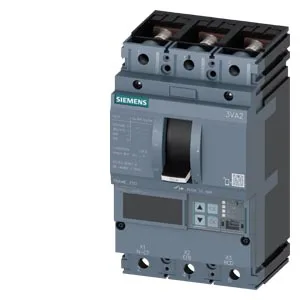
Its headline breaking capacity hits 242 kA at 240 V and 187 kA at both 415 V and 440 V — numbers that tell you it can interrupt very high fault currents without upstream coordination failure, which matters when you're protecting a main feeder or a high-capacity distribution bus. Derating is real on this frame: the 250 A rating holds up to 50 °C ambient, then drops to 238 A at 55 °C and 200 A at 70 °C. Mechanically, it carries 20 000 latching endurance cycles, which is typical for a distribution-frame MCCB — not a switching-duty contactor, but fine for infrequent breaker operation.
Integration and footprint
The dimensions are 86 mm deep, 105 mm wide, 181 mm tall — that width is the 3-pole frame size, so it occupies roughly the same footprint as other 3VA2 250 A units. The depth (86 mm) is the dimension that matters for enclosure depth clearance behind the door or gland plate.
For BOM freeze or PCN watch: this is a mainstream SENTRON 3VA2 catalog item. If you are sourcing for a new panel design, the 3VA2 platform is Siemens' current-generation MCCB family, so long-term availability is expected.
Comparison: 3VA2225-5JQ32-0AK0
The closest functional sibling is 3VA2225-5JQ32-0AK0, which shares the same 250 A frame, 3-pole count, and ETU560 trip unit. The key difference is the auxiliary contact configuration: this -6JQ32-0KC0 carries 2 HQ auxiliary switches, while the -5JQ32-0AK0 carries a different auxiliary contact variant. Both use the same basic switch (3VA2225-6JQ32-0AA0) and the same integrated auxiliary trip (3VA9688-0BL33), so the physical footprint and wiring interface are identical. If your BOM specifies the -5JQ32-0AK0 and you have the -6JQ32-0KC0 in hand, the swap is drop-in — no rewiring or panel modification needed — as long as the auxiliary contact count matches your control scheme.