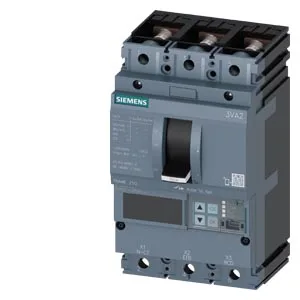
At 415 V and 440 V, that capacity holds at 187 kA, dropping to 121 kA at 500 V and 4.5 kA at 690 V, so the voltage class of your service entrance governs which rating applies. The continuous current derates with ambient temperature: 250 A holds through 50 °C, then steps down to 238 A at 55 °C, 225 A at 60 °C, 213 A at 65 °C, and 200 A at 70 °C — meaning a panel running at 60 °C ambient loses 10 % of the breaker's ampacity, and you'd size the upstream feed accordingly.
The 3-pole body occupies roughly 4 inches of rail width; plan for the 86 mm depth when routing busbars or cable ladders behind the panel gland plate. Maximum power loss is 50.5 W, which contributes to the enclosure's thermal budget — in a sealed cabinet, that loss plus the other breakers in the same row may push the internal temperature above 50 °C, triggering the derating curve noted above.
The trip indicator gives a local mechanical flag for fault events. No ground-fault monitoring version is fitted — that function is external if required.