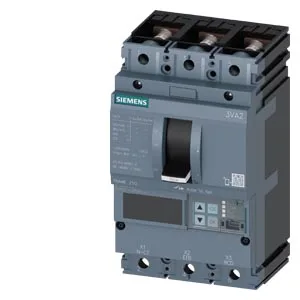
The Siemens SENTRON 3VA2225-6KP32-0KL0 is a 3-pole molded case circuit breaker (MCCB) rated for 250 A continuous current at 40 °C, with a breaking capacity of 242 kA at 240 V. At 415 V and 440 V the rating holds at 187 kA, dropping to 121 kA at 500 V, and 4.5 kA at 690 V. The continuous current derates as ambient rises: still 250 A at 50 °C, then 238 A at 55 °C, 225 A at 60 °C, 213 A at 65 °C, and 200 A at 70 °C. If your panel runs hot, size the load accordingly — the 70 °C figure is the operating maximum per the datasheet. This is a line-protection design (not motor-protection), meaning it's intended for feeder circuits and distribution panels rather than individual motor overload protection. It includes a communication function, a trip indicator, and a voltage trigger. No undervoltage release is fitted, and no ground-fault monitoring is included — if you need those, you'd be looking at a different variant.
Maximum power loss is 48 W. Dimensions are 105 mm wide, 181 mm high, 86 mm deep — the 105 mm width is the standard 3-pole MCCB footprint for this SENTRON frame size, so it fits existing panel cutouts and busbar arrangements without modification.
Deployment context
This MCCB mounts in a distribution panel or switchboard — it's a panel-mount device, not DIN-rail snap-on. The 105 mm width and 181 mm height fit standard SENTRON 3VA2225 frame cutouts. The shunt trip (STL) allows remote tripping for emergency-stop or supervisory control circuits. The communication function supports integration with higher-level monitoring systems, though the specific protocol is not detailed in this listing.