What the interrupting ratings mean for your panel
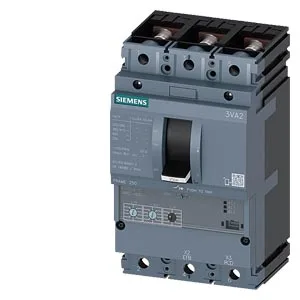
The Siemens SENTRON 3VA2225-7HL32-0DL0 is a 3-pole molded case circuit breaker (MCCB) rated for line protection, carrying a continuous current Iu of 250 A. Its interrupting capacity is the headline figure: 330 kA at 240 V, 242 kA at 415 V and 440 V, 187 kA at 500 V, and 6.3 kA at 690 V. Those are not theoretical maximums — they are the fault currents this breaker can safely interrupt without welding contacts or rupturing the case. For a sourcing decision, the 415 V figure (242 kA) is the one that governs most industrial low-voltage distribution in 400 V class systems; it tells you this MCCB can sit at the main incoming position where fault current is highest, not just a downstream feeder.
Thermal derating — the real current you get at panel ambient
The 250 A rating holds from 40 °C through 50 °C without derating. At 55 °C it drops to 241 A, at 60 °C to 232 A, at 65 °C to 222 A, and at 70 °C to 213 A. If your panel ambient runs at 60 °C — common in a sealed enclosure with other heat sources — you lose 18 A of headroom. The maximum power loss is 50.5 W, which factors into the enclosure thermal calculation. Operating range is -25 °C to 70 °C; storage range is -40 °C to 80 °C.
Auxiliary and release configuration
The breaker ships with an ETU320 electronic overcurrent release and an undervoltage release (UVR) as the auxiliary release design. The auxiliary contact block is configured as 2 auxiliary switches + 1 trip alarm switch + 1 electrical alarm switch HQ. The basic switch assembly is order code 3VA2225-7HL32-0AA0; the integrated auxiliary trip module is 3VA9608-0BB25. A trip indicator is present. No communication function, no phase failure detection, no ground fault monitoring, and no voltage trigger are included on this variant.
Physical fit and panel integration
Dimensions are 105 mm wide, 181 mm high, and 86 mm deep. The width is the critical panel cutout dimension — 105 mm is the standard 3-pole MCCB footprint for this class, so it fits existing SENTRON 3VA mounting bases and busbar connections without adapter plates. The rated insulation voltage is 800 V, and latching endurance is rated at 20 000 operations.
