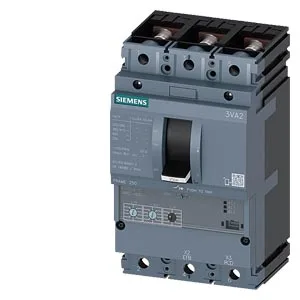
What this MCCB is and what it does
The Siemens 3VA2225-7HL32-0JA0 is a SENTRON molded case circuit breaker (MCCB) designed for line protection — meaning its primary job is protecting cable and busbar runs, not a specific motor or load. It's a 3-pole unit rated 250 A continuous, and it carries a shunt trip release (STL) for remote or emergency-off tripping. The breaking capacity is the headline here: 330 kA at 240 V, 242 kA at 415 V and 440 V, 187 kA at 500 V, and 4.5 kA at 690 V. That 330 kA figure at 240 V tells you this breaker is sized for high-fault-capacity distribution panels where the available short-circuit current is substantial — common in industrial switchgear or transformer-secondaries. The shunt trip means a control signal (from an E-stop, PLC, or fire-alarm relay) can open the breaker remotely, which is the usual integration point in a safety circuit.
Thermal derating — the real-world current limit
The 250 A continuous rating holds flat from 40 °C up to 50 °C ambient. Above that, it derates: 241 A at 55 °C, 232 A at 60 °C, 222 A at 65 °C, and 213 A at 70 °C. If this breaker lands in a non-air-conditioned panel or a hot enclosure near a furnace line, the 70 °C figure is the one that governs — 213 A is what you actually get, not the nameplate 250 A. The maximum operating temperature is 70 °C, so the derating curve is the full story; there's no headroom beyond that.
Physical fit and panel integration
Dimensions are 105 mm wide, 181 mm tall, 86 mm deep. That width is the standard 3-pole MCCB footprint for the SENTRON 3VA2 frame — it occupies three 35 mm DIN-rail modules plus the breaker body overhang. The 86 mm depth includes the arc chamber and the shunt trip mechanism; verify clearance behind the panel door if the breaker is mounted near a backplane or busbar stack. No auxiliary switch is fitted (design of auxiliary switch: without), so if you need status feedback to a PLC, you'll add a separate auxiliary switch block.
