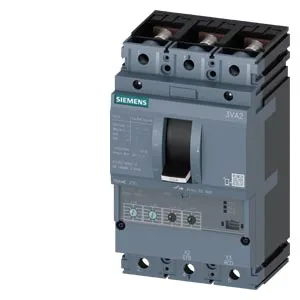
The Siemens SENTRON 3VA2225-7HN32-0CL0 is a 3-pole molded case circuit breaker rated for 250 A continuous current at 40 °C, with a 330 kA interrupting capacity at 240 V AC — a figure that drops to 242 kA at 415 V and 187 kA at 500 V, then to 4.5 kA at 690 V. The 250 A rating holds flat through 50 °C, then derates to 241 A at 55 °C and 213 A at 70 °C, so the thermal margin is generous for a 200 A continuous load in a 40 °C panel. The trip indicator is present, and there is no voltage trigger or communication function — this is a standalone protective device, not a networked power manager.
Integration and fit
The depth of 86 mm (3.39 in) is the dimension from the mounting plane to the rear of the case; verify clearance behind the panel for the arc chamber and wiring channels. The width of 105 mm (4.13 in) governs the DIN-rail or screw-mount pitch — standard for a 250 A frame in this family. The undervoltage release (UVR) is factory-installed; verify coil voltage against the control circuit before commissioning. The auxiliary switch complement (2 aux + 1 trip alarm + 1 electrical alarm) provides sufficient status feedback for a PLC-based motor control center without an external interface module.