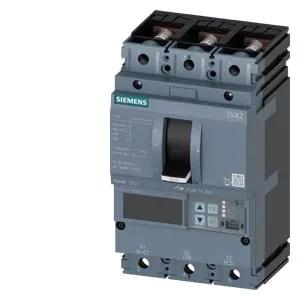
It's a line-protection design, meaning it's intended to guard feeders and distribution buswork against overload and short-circuit faults — not a motor-protection breaker with integrated overload relay. Rated insulation voltage is 800 V, and the interrupting capacity runs 330 kA at 240 V, 242 kA at 415 V and 440 V, 187 kA at 500 V, and 4.5 kA at 690 V.
Thermal derating — the real-world continuous current
At 55 °C it derates to 238 A, at 60 °C to 225 A, at 65 °C to 213 A, and at 70 °C to 200 A. In a packed panel where internal ambient runs toward 55–60 °C, you're effectively working with a 225–238 A breaker, not 250 A. That matters for NEC 110.14(B) termination temperature limits and for ensuring the breaker doesn't nuisance-trip on a warm day when the load is near nameplate.
Integration — panel fit and connectivity
The breaker supports communication (fieldbus or Modbus via a communication module — not integrated into the base unit) and has an IP40 rating on the front, meaning finger-safe but not washdown-rated.