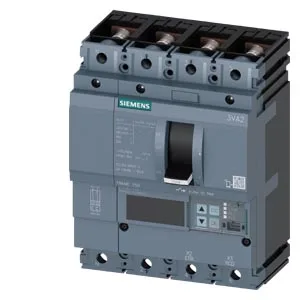
Its interrupting capacity reaches 330 kA at 240 V, scaling down to 242 kA at 415/440 V, 187 kA at 500 V, and 4.5 kA at 690 V — meaning it clears high-fault currents at typical industrial voltages without cascading upstream.
The 250 A continuous rating holds at 40 °C, 45 °C, and 50 °C without derating; at 55 °C it drops to 238 A, at 60 °C to 225 A, at 65 °C to 213 A, and at 70 °C to 200 A. The adjustable thermal-magnetic trip range spans 375 A minimum to 2 500 A maximum (short-time/instantaneous), with a fixed 50 A initial value for the electronic trip unit. The 250 A full-scale value matches the continuous rating, so the breaker coordinates with downstream feeders without nuisance tripping on motor inrush. Ground-fault monitoring uses summation current formation on L+N conductors — it detects leakage by summing the phase and neutral currents, not by a separate sensor. This is typical for solidly-grounded wye systems where you need GF protection without an external relay. Rated insulation voltage is 800 V, so the breaker can be applied on 480/277 V and 600/347 V systems with margin.
The 4-pole form factor occupies the same footprint as three-pole plus neutral, so verify busbar and phase barrier spacing if replacing a 3-pole breaker. Communication function is onboard (likely PROFIBUS or PROFINET via the 3VA COM module), enabling remote trip indication, current metering, and parameterization. No undervoltage release or voltage-trip accessory fitted from the factory — those are field-installable options.