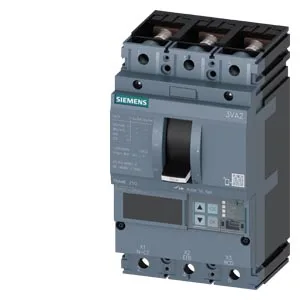
The 250 A frame carries a thermal derating curve that holds full rating up to 50 °C, then steps down: 238 A at 55 °C, 225 A at 60 °C, 213 A at 65 °C, and 200 A at 70 °C. That matters when you're packing breakers into a warm enclosure — the 50 °C ceiling buys you headroom most 80%-rated frames don't.
Breaker frame size is 375 A minimum to 2 500 A maximum, so this 250 A continuous rating sits well inside the frame's capability — you're not pushing the thermal limits. Communication function is built in, so it can talk to a higher-level system for power monitoring or selective coordination schemes.
The interrupting ratings cover the common distribution voltages: 330 kA at 240 V, 242 kA at 415 V and 440 V, 187 kA at 500 V, and 4.5 kA at 690 V. That 4.5 kA figure at 690 V is the pinch point — if your system runs 690 V with high fault current, this breaker's not your choice. But for 240–500 V distribution, those numbers give you selectivity headroom for downstream breakers. Maximum power loss is 50.5 W, which factors into enclosure thermal calculations when ganging multiple breakers.
The width at 105 mm for a 3-pole frame is standard for this class; check your busbar or lug spacing against the terminal pattern before committing. The trip indicator is present, so you get a visual flag on fault without needing to meter it.