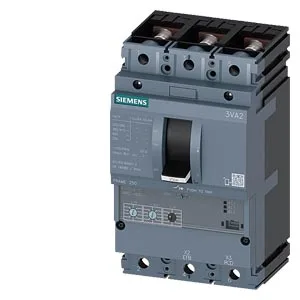
MCCB for high-fault panels — 250 A, ETU320, 3-pole
At 240 V it interrupts fault currents up to 440 kA, dropping to 330 kA at 415 V and 440 V, 242 kA at 500 V, and 50.4 kA at 690 V — figures that place it in the high-breaking-capacity tier for main feeder or large subfeed applications where upstream transformer or generator fault levels are substantial. The ETU320 release provides adjustable thermal-magnetic or electronic trip curves depending on the variant; this unit ships as the line protection version, meaning it is set for cable and busbar protection rather than motor or generator duty.
At 55 °C it steps to 241 A, then drops linearly to 213 A at 70 °C. If the panel sits near a heat source or in a non-conditioned enclosure, size the downstream conductor and bus for the derated value at the actual ambient.
With 440 kA breaking capacity at 240 V and 330 kA at 415 V, this MCCB can be applied downstream of a larger 3VA frame or upstream of smaller 3VA or 5SY MCBs while maintaining full selectivity — the ETU320's adjustable I²t curve allows coordination studies. Maximum power loss is 50.5 W at rated current, which should be included in the enclosure thermal calculation. The unit has no phase-failure detection and no ground-fault monitoring — those functions require a different release variant or an external module.