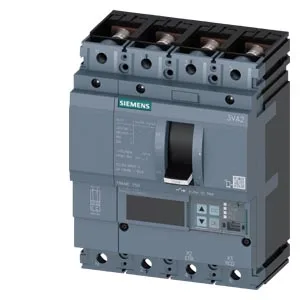
It breaks up to 440 kA at 240 V and still holds 330 kA at 415 V and 440 V — that's serious fault-clearing headroom for a 250 A frame. The thermal derating curve starts at 55 °C (238 A) and drops to 200 A at 70 °C, so if this lands in a hot enclosure, you're not getting the full 250 A out of it without some ventilation planning. Ground-fault monitoring uses summation current formation on L+N conductors — it watches the vector sum, not a separate sensor. That means it catches leakage without needing an external GFCI module, but it also means the neutral must pass through the breaker. No undervoltage release, no voltage trip, no trip indicator on this variant.
The 3VA2225-8JQ42-0AA0 measures 140 mm wide, 86 mm deep, 181 mm tall — a standard SENTRON 3VA frame size for this current class. The 4-pole width means it occupies the same footprint as a 4-module MCCB in a Siemens distribution board; verify the backpanel cutout against the 140 mm width before slotting it into an existing layout.
Drop to 690 V and the breaking capacity falls to 52.5 kA, which is still high for a 250 A frame but tells you the arc extinction is voltage-sensitive. For selectivity studies, the 330 kA at 415 V is the number most European panel builders will use; the 220 kA at 500 V covers 480 V North American systems with headroom.
Communication function onboard
This variant includes a communication function — the 3VA platform supports PROFIBUS, PROFINET, or Modbus via plug-in modules, though the exact protocol depends on the communication module ordered alongside the breaker. The base breaker ships with the communication-ready interface; the module is a separate order code. If you need remote trip indication, energy metering, or parameterization over a network, this is the right base variant to start from.