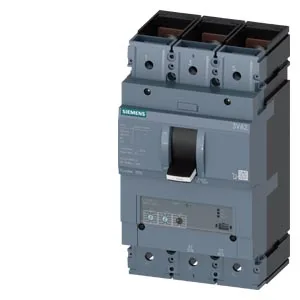
It carries a continuous current rating of 250 A across the full ambient range from 40 °C to 70 °C, meaning no derating is needed as the panel warms up; the breaker delivers its full 250 A at 70 °C ambient. Breaking capacity is the key selection number for fault duty. At 240 V it interrupts 187 kA; at 415 V and 440 V it holds 121 kA; at 500 V it drops to 75.6 kA; at 690 V it is still rated at 7.5 kA. The 3-pole design (3 poles) and the trip indicator (trip indicator present) let the operator see at a glance whether the breaker has tripped on a fault — no need to probe with a meter on a darkened panel. Dimensions are 248 mm high, 138 mm wide, 110 mm deep — a standard SENTRON 3VA frame size that fits the usual DIN-rail or mounting-plate footprint for 250 A MCCBs. The auxiliary switch configuration (1 auxiliary switch + 1 trip alarm switch HQ) provides one N.O./N.C. set for status feedback and a separate alarm contact that closes only on a trip event, not on manual switching.
The 138 mm width occupies three module spaces on a DIN rail. Power loss is 37.5 W maximum at rated load. In a sealed, non-ventilated enclosure, that heat must be factored into the thermal budget — at 250 A continuous, the breaker itself runs warm, so keep adjacent wiring and components clear of the top vent slots.