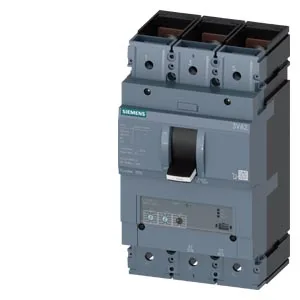
It is a 3-pole line-protection breaker, meaning it sits in the main feeder or a large subfeed to protect cables and busbars from overload and short-circuit faults — not a motor-protection device with phase-failure detection. Rated insulation voltage is 800 V, and the breaking capacity varies by system voltage: 187 kA at 240 V, 121 kA at both 415 V and 440 V, 75.6 kA at 500 V, and 17 kA at 690 V. That 187 kA at 240 V is high — it handles a very large fault current at low-voltage distribution levels, typical for a main breaker in a 240 V delta or 277/480 V wye panel where the available fault current is stiff. The ETU320 is a basic electronic trip unit — it provides LSI (long-time, short-time, instantaneous) protection curves but no ground-fault or communication functions.
At 55 °C it derates to 240 A, at 60 °C to 235 A, at 65 °C to 230 A, and at 70 °C to 225 A. Maximum power loss is 40 W.
That 138 mm width is a 3-pole frame — it fits standard MCCB mounting footprints in SENTRON distribution boards or on a mounting plate. The 110 mm depth includes the case body; add clearance for cable lugs and the auxiliary switch wiring.
Auxiliaries and releases
The integrated auxiliary trip is order code 3VA9608-0BB25; the basic switch (without auxiliaries) is 3VA2325-5HL32-0AA0. If you need a different auxiliary configuration, the base breaker accepts field-installable accessory kits.