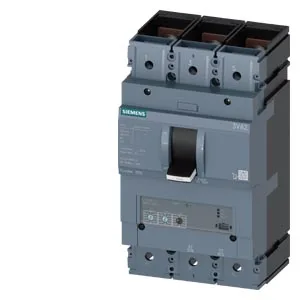
The Siemens SENTRON 3VA2325-5HL32-0HL0 is a 3-pole molded case circuit breaker rated for 250 A continuous current at 40 °C, with a rated insulation voltage of 800 V. The interrupting capacity hits 187 kA at 240 V, 121 kA at 415 V and 440 V, 75.6 kA at 500 V, and 17 kA at 690 V — that SCCR ladder tells you the breaker can clear a fault at the available fault current of your distribution transformer without rupturing, which is the deciding factor for switchboard coordination studies. Thermal derating is published from 40 °C through 70 °C: the breaker holds 250 A up to 50 °C, then drops to 240 A at 55 °C, 235 A at 60 °C, 230 A at 65 °C, and 225 A at 70 °C.
Auxiliary contacts and trip indication
That gives you separate dry contacts for status feedback (open/closed), a trip-indicating contact that latches on a fault, and an alarm contact for the ETU's internal event. Maximum power loss is 37.5 W — account for that in your enclosure thermal budget.
The 138 mm width is the 3-pole frame footprint — it occupies three 45 mm-wide module positions on a DIN rail or bolts directly to a mounting plate via the rear slots. The 110 mm depth includes the rotary handle and terminal shields; leave clearance for cable bending radius below the line and load lugs.