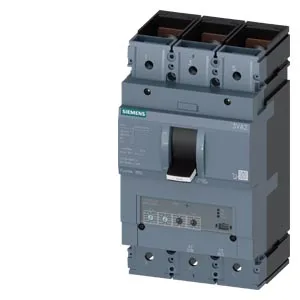
Breaking capacity across the voltage range
The 3VA2325-5HN32-0AJ0: The interrupting rating is what decides whether this breaker clears a fault without welding its contacts or venting arc gas into the enclosure. At 240 V it delivers 187 kA; at 415 V and 440 V it holds 121 kA; at 500 V it still manages 75.6 kA; at 690 V it drops to 17 kA. That spread covers most industrial distribution voltages in North America (277/480 V) and Europe (400/690 V), but the 690 V figure means you need to verify coordination if the transformer secondary is above 500 V.
Thermal derating and panel loading
Rated continuous current is 250 A up to 50 °C ambient. Above that, the breaker derates: 240 A at 55 °C, 235 A at 60 °C, 230 A at 65 °C, and 225 A at 70 °C. If the panel internal temperature runs hot — say, a packed enclosure with drives — you lose 25 A by the time you hit 70 °C. Factor that into the load schedule; don't assume the nameplate 250 A holds in a sealed cabinet.
Trip unit and auxiliary contacts
The ETU350 electronic trip unit provides adjustable overload and short-circuit protection curves without needing a separate power supply — it's self-powered from the line current. The breaker ships with 2 auxiliary switches plus 1 trip alarm switch (HP type), which is enough to signal the breaker state to a PLC or remote I/O without adding a separate aux block. No undervoltage release, no ground-fault monitoring, no communication module on this variant; if you need those, the 3VA2 family has other order codes with those options pre-installed.
Physical fit and mounting
Dimensions are 248 mm high, 138 mm wide, 110 mm deep. The 138 mm width is the standard 3-pole MCCB footprint for this class — it fits the SENTRON panelboard mounting pattern and the common DIN-rail adapter plates. IP40 on the front means it's protected against tools and wires >1 mm, but not against dust ingress; keep it inside a sealed enclosure if the environment is dirty.