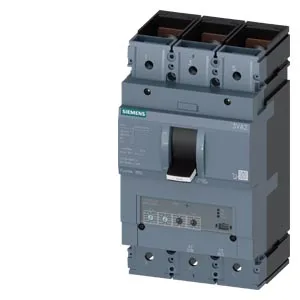
That 250 A holds flat through 50 °C — you only start seeing derating at 55 °C (240 A) down to 225 A at 70 °C, so it's a solid pick for a warm panel or outdoor enclosure where ambient climbs. The interrupting ratings are the headline here: 187 kA at 240 V, 121 kA at both 415 V and 440 V, 75.6 kA at 500 V, and 17 kA at 690 V. The overcurrent release is an ETU350 — that's a basic electronic trip unit with LSI curves (long-time, short-time, instantaneous). It's a workhorse MCCB for standard distribution and motor feeder protection where you don't need the bells of a 3VA2 with a 3VA9 communication module.
Footprint is 138 mm wide, 248 mm tall, 110 mm deep. That's a standard 3VA2 frame size — it bolts into the same mounting pattern as other 250 A SENTRON MCCBs. No DIN-rail mount on this class; it's fixed by four screws to a backplate or busbar system. Wireway planning: at 250 A you're looking at parallel runs of 70 mm² or 95 mm² copper, so leave at least 150 mm clearance below the breaker for cable sweep.
In practice, for selectivity coordination downstream of a larger feeder, you'd look at the short-time withstand and the ETU350's adjustable I²t curves. The 121 kA at 415 V is the figure most European 400 V panels care about; the 17 kA at 690 V is the ceiling for 690 V industrial networks.
Endurance and thermal budget
Mechanical endurance is 15,000 operations — that's typical for a 250 A frame MCCB used in distribution, not for frequent switching duty. If you're cycling this breaker daily as a disconnect, you'll wear it out faster than the 15k cycles. The maximum power loss is 40 W at rated current; that's heat that has to be dissipated inside the enclosure. In a sealed panel with multiple breakers, factor that into the thermal calculation — 40 W per pole is 120 W total for this 3-pole unit at full load.