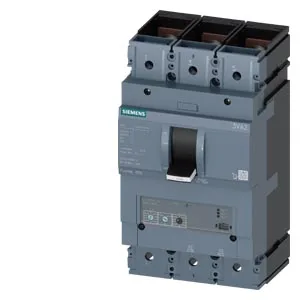
MCCB for motor protection — 250 A, 3-pole, ETU350M release
It carries an ETU350M electronic overcurrent release with phase failure detection, so it can handle the inrush and thermal characteristics of a motor load without nuisance tripping on start-up — that's the difference between a general-purpose MCCB and one specced for motor branch circuits. Breaking capacity is 187 kA at 240 V, 121 kA at 415 V and 440 V, 75.6 kA at 500 V, and 17 kA at 690 V. The 17 kA at 690 V still covers most 690 V industrial distribution. Thermal derating is published across the operating range: 250 A flat from 40 °C through 50 °C, then 240 A at 55 °C, 235 A at 60 °C, 230 A at 65 °C, and 225 A at 70 °C. If your panel ambient sits at 55 °C, plan for 240 A continuous — the breaker won't hold 250 A without nuisance tripping at that temperature.
Footprint is 138 mm wide by 248 mm tall by 110 mm deep. Maximum power loss is 37.5 W. In a sealed, low-ventilation panel, that heat needs to be factored into the thermal budget — especially if the breaker is mounted alongside other high-current devices. The 15 000 latching endurance cycles give a reasonable mechanical life for a motor-protection breaker in a production line that cycles a few times a shift.
It ships with 2 auxiliary switches (HQ type) pre-installed. The supplied basic switch is 3VA2325-5MN32-0AA0, which is the core switching mechanism inside the molded case.