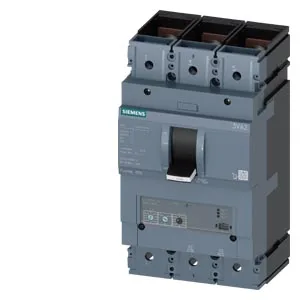
That phase-failure detection is important out here in the grease: a motor running on two phases draws high current on the remaining legs and burns up fast if the breaker doesn't catch it. This one does. That means if your control voltage drops out, the breaker opens without waiting for a fault. Handy for coordinated start/stop sequences or safety interlocks where you want the motor off when the control power goes away.
Breaking capacity — the real-world fault current it can handle
Breaking capacity is where this breaker earns its keep in heavy industrial panels. At 240 V it's rated 187 kA; at 415 V and 440 V it holds at 121 kA; at 500 V it's 75.6 kA; and at 690 V it's still 17 kA. The 690 V rating at 17 kA also tells you it's usable on 600 V class systems common in North American mining and oilfield installations.
Thermal derating — how hot can your panel get?
Above that it starts to step down: 240 A at 55 °C, 235 A at 60 °C, 230 A at 65 °C, and 225 A at 70 °C. That's a shallow derating curve — you lose only 25 A over a 20 °C rise from 50 to 70 °C. So if your panel runs warm because it's packed tight or sitting next to a hot process line, this breaker still carries most of its rated current. Plan your ventilation or enclosure sizing accordingly.
It mounts via the breaker's own base — no DIN rail adapter needed for this class of breaker; it bolts directly into the panel or onto a mounting plate. The 138 mm width means it occupies three 45 mm pole spaces if you're laying out a multi-breaker lineup.
What it doesn't have — and why that matters for your BOM
If your application requires any of those, you'd need a different variant in the 3VA2 family or an add-on module. The trip indicator is also absent, so there's no local mechanical flag showing whether the breaker tripped on overload or was manually opened. That's typical for the base motor-protection configuration — the ETU350M handles the protection logic, and you get the status from the undervoltage release circuit.