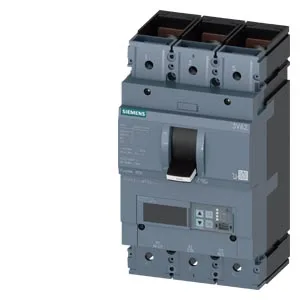
MCCB for motor branch circuits
The adjustable trip class (10A, 10/10E, 20/20E, 30/30E) lets you match the breaker's thermal curve to the motor's starting profile: set it to 10 for standard-start pumps and fans, or 20/30 for high-inertia loads like conveyors or crushers that need a longer start window.
Rated interrupting capacity hits 187 kA at 240 V, 121 kA at 415/440 V, 75.6 kA at 500 V, and 7.5 kA at 690 V. At 690 V the 7.5 kA rating is still adequate for most motor branch circuits, but verify against the available fault current if feeding from a large step-up transformer.
Measures 110 mm deep by 138 mm wide by 248 mm high. Depth of 110 mm leaves clearance for rear-connected accessories or cable entries in a 400 mm deep enclosure.
Listed as current production (active lifecycle stage). No known PCN or EOL notice on this order code.
Communication and monitoring
Includes communication function and phase failure detection. The communication capability allows integration into a plant-wide energy management or motor control system — the breaker can report trip events, load current, and status over a bus (typically via a communication module, not detailed here). Phase failure detection adds protection against single-phasing on a motor load, which is common in three-phase industrial circuits.