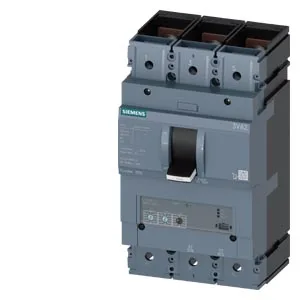
It's configured as a line-protection device, meaning it's tuned for feeder and main breaker duties rather than motor or generator protection — the trip curve and time delays are set for cable and busbar thermal limits. Breaking capacity is the headline: 242 kA at 240 V, 187 kA at 415 V and 440 V, 121 kA at 500 V, and still 40 kA at 690 V. That's a very high-interrupting frame — it's sized for installations where fault current runs high, like large transformer secondaries or industrial substations. The 690 V rating matters for 600 V class North American systems and for 690 V European industrial grids. Current rating holds flat at 250 A from 40 °C up through 50 °C ambient. Derating starts at 55 °C (240 A), stepping down to 225 A at 70 °C. That's a solid thermal budget — most panel interiors stay below 50 °C, so you get full rating without a derate factor.
Trip unit and auxiliaries
It gives adjustable pickup and time-delay settings for selectivity coordination downstream — critical when you're cascading MCCBs in a distribution board and need the fault to clear at the closest device. That's enough for remote status indication — open/closed on the aux, tripped on the alarm. The basic switch assembly carries order code 3VA2325-6HL32-0AA0, and the integrated auxiliary trip module is 3VA9608-0BB11. If you're stocking spares, those are the sub-assembly references.
The 110 mm depth is the projection from the mounting surface; plan for front-access cabling and clearance for the arc-chamber venting. Maximum power loss is 37.5 W — not negligible in a sealed enclosure; factor it into the thermal calculation if the panel is IP54 or above. Mechanical endurance is 15,000 operations.