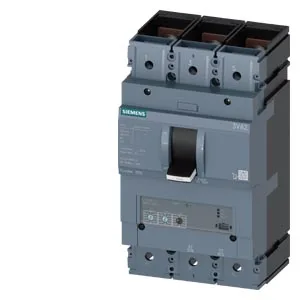
The Siemens SENTRON 3VA2325-6HL32-0HA0 is a 3-pole molded case circuit breaker rated for 250 A continuous current (Iu) at 40 °C, with an ETU320 electronic overcurrent release. The breaking capacity is the headline: 242 kA at 240 V, 187 kA at 415 V and 440 V, 121 kA at 500 V, and 40 kA at 690 V. Those numbers tell you this breaker handles high-fault-current scenarios — transformer secondaries, large busway feeds, or industrial mains where available fault current runs high. The ETU320 release gives adjustable long-time, short-time, and instantaneous pickup, plus ground-fault alarm or trip if you add the optional module.
At 55 °C it derates to 240 A, then 235 A at 60 °C, 230 A at 65 °C, and 225 A at 70 °C. The frame dimensions are 248 mm high, 138 mm wide, 110 mm deep — that's a standard 3VA2 frame footprint, so it drops into the same mounting holes and bus connections as other 3VA2 breakers in the 250 A class.
What's inside the can
The basic switch assembly carries order code 3VA2325-6HL32-0AA0. The integrated auxiliary trip is 3VA9688-0BL30 — that's the shunt trip coil that lets a remote signal or emergency-stop circuit open the breaker. The ETU320 release is field-configurable for LSI (long-time, short-time, instantaneous) protection curves.