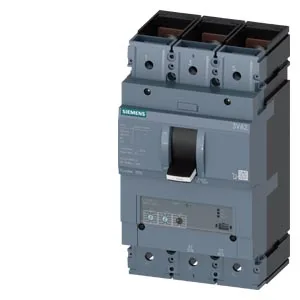
What the breaking capacities mean for your panel
At 415 V and 440 V it still holds 187 kA, and at 690 V it's rated 40 kA. For a panel designer, those numbers mean this breaker handles high-fault locations like a main incoming feeder or a large motor control center bus without needing upstream current-limiting fuses.
Thermal derating and the ETU320 release
Above that, it drops: 240 A at 55 °C, 235 A at 60 °C, 230 A at 65 °C, 225 A at 70 °C. The overcurrent release is an ETU320, a microprocessor-based trip unit that gives adjustable long-time, short-time, and instantaneous protection curves. That matters when coordinating downstream breakers — you can shape the trip to achieve selectivity without sacrificing response on hard faults.
Auxiliary contacts and shunt trip — what's built in
The shunt trip lets you remotely open the breaker via a control voltage — useful for emergency-stop circuits or PLC-controlled disconnects. The auxiliary contacts report the breaker's open/closed status back to a controller or indicator lamp.